

Sometimes it’s important to stop and appreciate how quickly things can change while out sailing. The Pacific coast of Baja brought a lot of that.
First, I decided to bring aboard crew for my Pacific crossing. One hope I have for them is that they’ll keep me from getting burned out during my times at anchor. Coming down from San Francisco to Ensenada I found that I was really happy to be sailing alone for days on end – but when I began thinking practically about island hopping I suspected that I’d lose interest with unoccupied solitude in remote anchorages.
Second, on day three of our trip south we lost control of the rudder in some serious weather. Here’s a synopsis copied from my journal entry:
—
We arrived in La Paz three days ago. I did not intend on coming to La Paz, but on the way south from Ensenada we lost the rudder in bad weather. It’s at least somewhat remarkable how close I came to losing my boat that night.
[Cori (one of the new crew members) was on watch.] We were on an eastbound heading with the wind to our backs. We were about 5 miles south of shore when an accidental gybe put our nose into the wind. I was below deck when it happened.
I felt the boat begin to alter course slightly and just as I wondered if were were moving towards a gybe, heard the crash. [I didn’t have a preventer, from that point forward I’ve been using one with many more gybes prevented.]
Without instrumentation for measuring wind speed it’s hard to say for sure, but based on my best estimates I’d say the winds were blowing ~35 knots and gusting into the 40’s.
Fortunately I put a reef into our main earlier in anticipation of winds in the 20’s (forecasted by PredictWind).
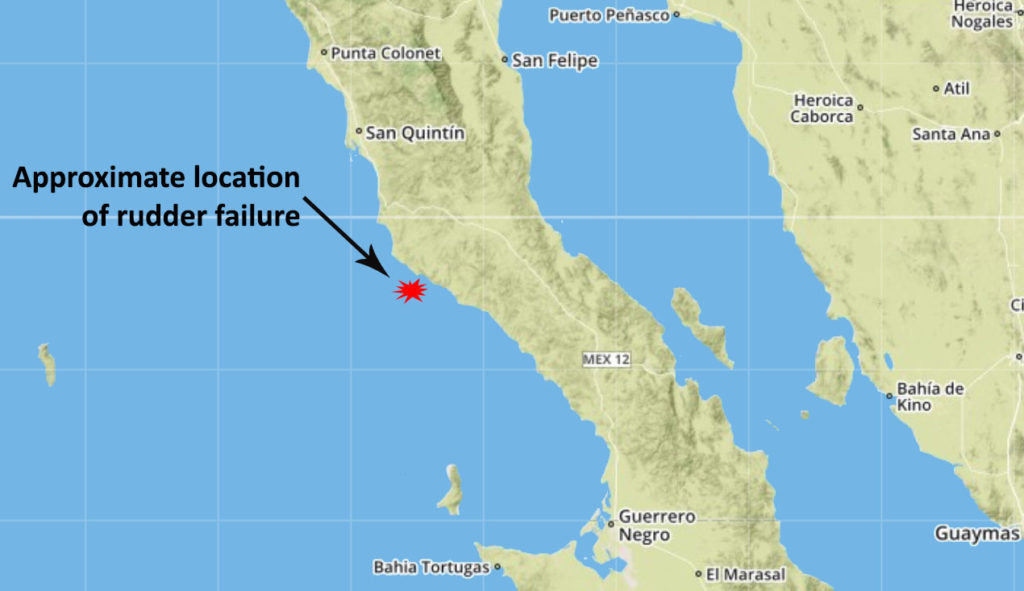
[After the shit hit the fan] I managed to get a second reef into our main, though it was extremely difficult doing so [given the conditions]. My primary concern was getting us away from what was now a lee shore. With the reef in the main we were able to continue moving southwest into the wind at about 1 – 1.5 knots.
The rest of the night was spent under the dodger and down below praying to a god that I don’t believe in that we’d make it through the night. We were thrown several times by massive breaking waves and my mind turned to the possibility of a capsize [though I felt the possibility to be fairly remote].
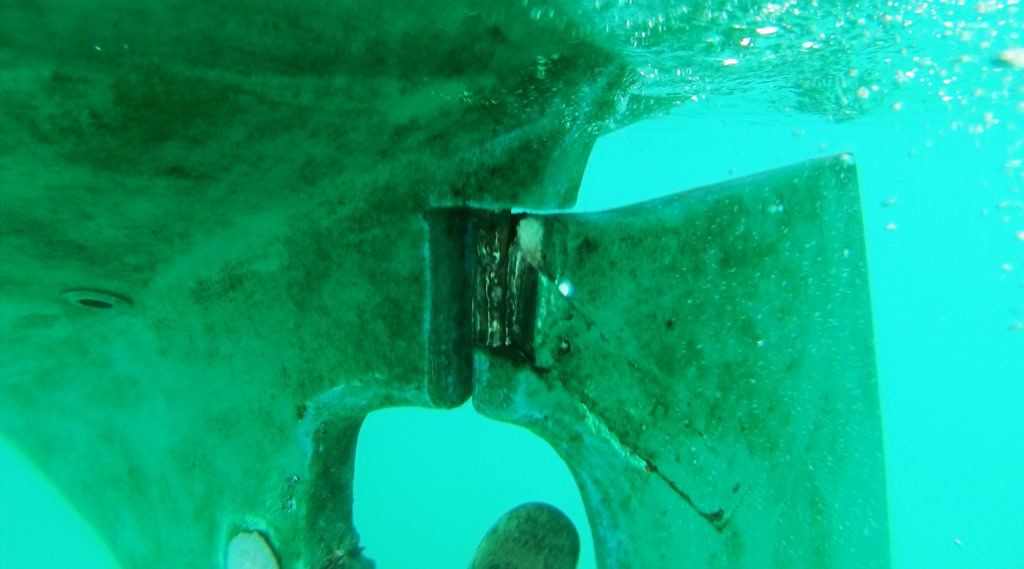
After a couple hours of pounding, I began hearing crunching noises which coincided with our being thrown off the waves. My initial thought turned to the rudder, which in the morning proved to be the case. In the back of my mind I also had a nagging concern that what I was hearing could be the keel, and was haunted by the fear that we wouldn’t be able to access the life raft in the event that we turtled without the ability to right ourselves again.
It was of comfort to know that this vessel has an encapsulated keel [which as far as I’m aware have zero history of failure] and that if it was the rudder, the Hydrovane should theoretically be capable of adequately steering us. In retrospect, it’s a bit chilling to consider what our fates would have been if I had decided not to install that piece of equipment or if it failed, too.
The rudder’s failure occurred at a point when we were closest to shore – and without steering it wouldn’t have taken more than an hour or two to get beached or blown into rocks. With the seas as they were I’d expect ADAMEK would have been pounded to pieces fairly quickly.
It was during this ordeal that my resolve for this trip was tested more than any time prior.
Daylight brought calmer conditions, so I decided to test my suspicions that I’d been listening to the rudder being torn from it’s shaft. When I found that there was no discernible affect by the helm on our course, my fears were confirmed.
With this revelation, I decided to alter our intentions. Rather than making a leisurely pace down the peninsula to Cabo San Lucas where we would depart for French Polynesia, we’d instead go for La Paz where services are significantly more affordable. I didn’t want to prevent Cori and Ben from enjoying the journey entirely, so I decided to briefly stop over in Turtle Bay and Cabo San Lucas at any rate.
The Hydrovane was surprisingly effective as a primary steering device, and the absence of our main rudder forced me to get better at trimming/balancing the sails, as well as learn the use of the vane more fully. As a matter of fact, I was so comfortable with the Hydrovane’s operation that I even had a cursory thought that we could forego the rudder repairs for now.
In the end though, I decided that such thing would have been the height of negligence considering the scope of this trip [and that I am now responsible for crew].
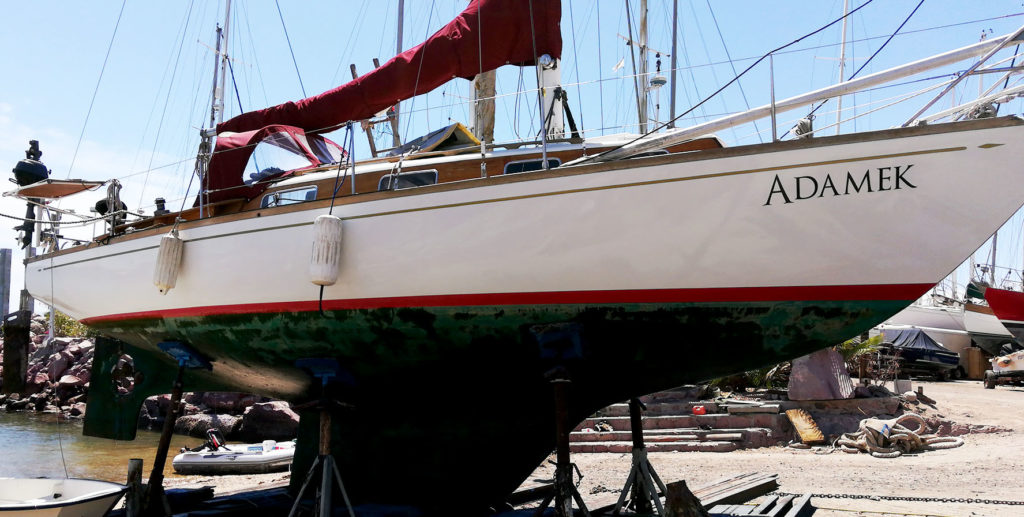
Here in La Paz, we have a number of repairs/modifications to make. These include:
- Repairing the rudder (completed 4/10/18)
- Modifying the tow gen props [to get more RPMs] (completed 4/7/18)
- Adding 3-way valve to the watermaker intake
- Adding ammeter to tow gen
- Have diesel lines between pump and injectors remade
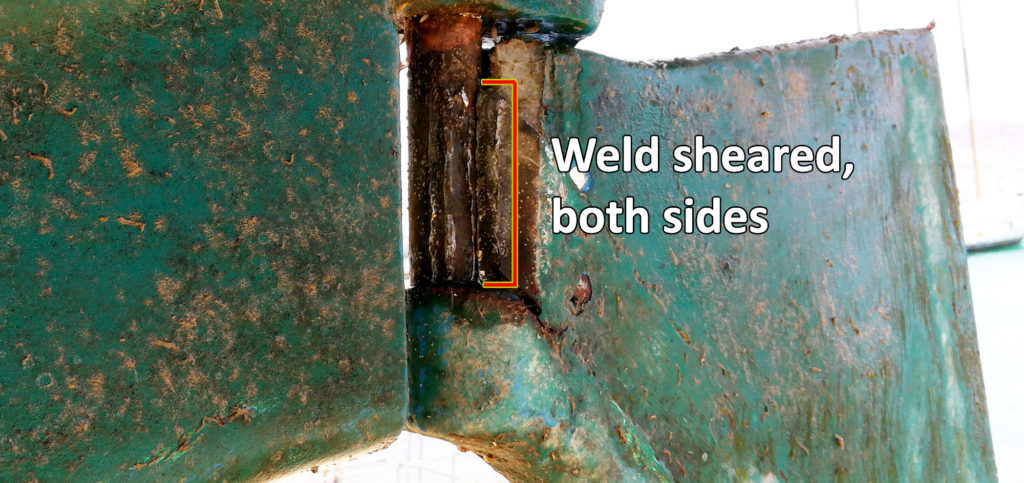
Primary concerns are to fix the diesel leak which has haunted me since purchasing the boat as well as insure we have sufficient ability to generate power and desalinate water.
—
As of Tuesday (two days ago) the rudder is fixed and we’re back in the water. I’ll have a follow-up about the repair work and a comparison of La Paz boatyards for anyone’s future reference.
The Author



3 Comments
Jacob:
It has been a long time since you have posted. I am hoping all is well with you.
The rudder incident sounded very hairy, but I hope things have smoothed out a bit since then.
Best Regards from Dock 5, Brisbane Marina, Alan
Hi there Alan,
I’ve really neglected my blog – quite a bit has happened since my last post which I’ll need to cover in due time. During the crossing my mom got really sick, and it became clear that I’d need to come back home and help take care of things (selling her house, finding her a care facility, etc).
So after arriving in the Marquesas I put the boat into storage and flew back to California, which is where I am now. I’ll remain here until some time next year. No saying when really, it’s largely dependent on what happens with my mom’s health. I’m currently staying in Long Beach and San Diego.
The crossing itself went smooth, spent quite a bit of time bobbing through the Doldrums but in the end we made it across in 33 days. Hope you’ve been well, let’s catch up if you happen to come down this way
Jacob
Just a month since you wrote to me: hey that’s pretty quick by my standards.
When I was much younger I use to correspond by mail with friends, and if they did not get any response then they would send me another letter….” I hope that you received my letter of September 11th, but I have not received a reply!” Some things don’t change, at least in my world!
I was really sorry to hear of your mothers illness, and of your need to return to the mainland. I hope that by your presence back here, you have been able to stabilize her situation and at least make things reasonable.
I did not really “meet” your mother, but from her presence on the dock once, I must assume that she has MS or MD, and therefore her care is unusually complicated. I was an x ray tech for many years here in SF, so I have some idea
what you may be dealing with.
I hope that at some point you will be able to “rescue” your boat back into life and continue the journey, I look forward to hearing another bulletin regarding your adventure, or, your life in Southern California.
Meanwhile, here in Brisbane I continue to varnish and paint, and generally care for this old GB 32. Perhaps I am crazy for doing this, but somehow, since I did this with racing dingys in my teens, it seems fitting to keep doing it with an old trawler in my retirement! Best Regards, Alan